
PUBLICATIONS
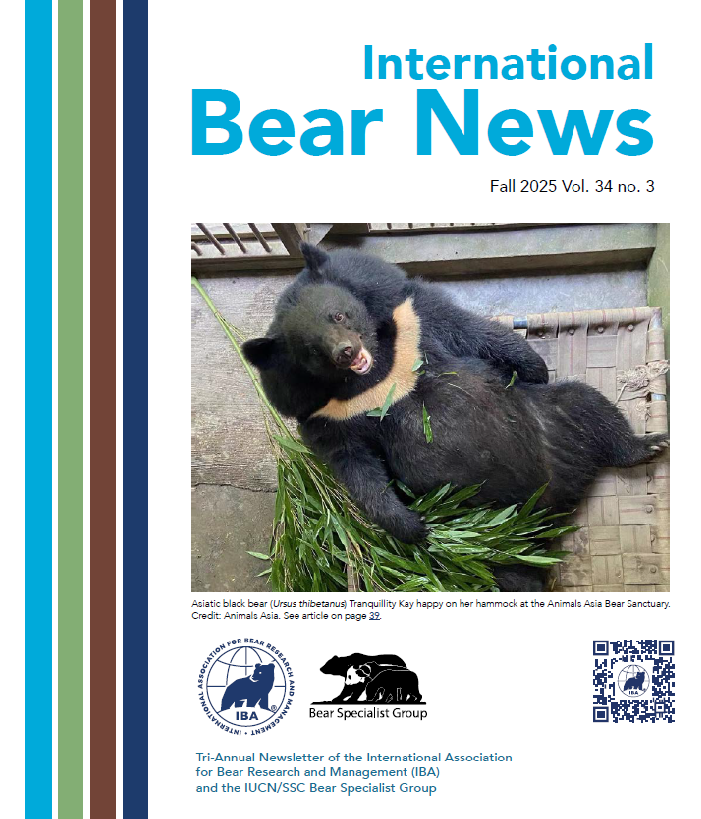
Our work has been featured in the International Bear News (IBN) tri-annual newsletter for global insights on bear biology, conservation, and culture! Check out pages 20-23 to learn more about our Initiatives in Grizzly Bear Fracture zones.
Supporting Grizzly Bear Recovery and Human-Bear Coexistence through Bear Smart Initiatives, Safe Wildlife Corridors, and Social Acceptance in Southwest, BC, Canada. Ciarniello, L.M.. International Bear News. Tri-Annual Newsletter of the International Association for Bear Research and Management (IBA) and the IUCN/SSC Bear Specialist Group. Fall 2025 Vol 34. no. 3; pg 20-23.
“Through Bear Smart initiatives, connectivity modelling, and the Conflict to Coexistence AC program, C2C demonstrates how multi-scaled, multi-stakeholder approaches can advance human safety and grizzly bear conservation. Continued investment in proactive approaches is essential to ensure recovering populations in southwest BC contribute to the stability of grizzly bears across their historic range.”
RESEARCH

Photo from Jeremy Williams.
Boulanger J, Stenhouse GB (2014). The Impact of Roads on the Demography of Grizzly Bears in Alberta. Public Library of Science, PLOS ONE 9(12): e115535. doi:10.1371/journal.pone.0115535
MacHutchson, G., Proctor, M.F. (2015) The Effects of Roads and Human Action on Roads on Grizzly Bears and their Habitat. Trans-Border Grizzly Bear Project.
Proctor, M. et al. (2012). Population Fragmentation and Inter-Ecosystem Movements of Grizzly Bears in Westerns Canada and the Northern United States. Wildlife Monographs, 180: 1-46.
Hebbelwhite, M. (2011). Unreliable Knowledge About Economic Impacts of Large Carnivores on Bovine Calves. Journal of Wildlife Management, 75(8): 1724-1730.
Schwartz, C.C., Haroldson, M.A., & White, G.C. (2010). Hazards Affecting Grizzly Bear Survival in the Greater Yellowstone Ecosystem. Journal of Wildlife Management, 74(4):654-667.
Hamilton, A. (2008). Living in Bear Country: Increasing Municipal Compliance with the Bear Smart Program in British Columbia. Masters Thesis, Simon Fraser University.
Proctor, M.F., McLellan, B.N., & Strobeck, C. (2002). Population Fragmentation of Grizzly Bears in Southeastern British Columbia, Canada. University of Calgary.
Wielgus, R.B., Vernier, P.R., & Schivatcheva, T. (2002). Grizzly bear use of open, closed, and restricted forestry roads. Canadian Journal of Forest Research, 32: 1597-1606.
Hilderbrand, G.V., Hanley, T.A., Robbins, C.T., & Schwartz, C.C. (1999). Role of brown bears (Ursus arctos) in the flow of marine nitrogen into a terrestrial ecosystem. Oecologia, 121: 546-550.
Tardiff, S.E., & Stanford, J.A. (1998). Grizzly bear digging: Effects on subalpine meadow plants in relation to mineral nitrogen availability. Ecology, 79(7): 2219-2228.
REPORTS
2013 - Where the Wild Things Are: Options for shared bear stewardship in BC.
2013 - Securing a national treasure: Protecting Canada's Grizzly Bear. David Suzuki Foundation.
2012 - British Columbia Grizzly Bear Population Estimate. Ministry of Forests, Lands and Natural Resource Operations.
2012 - COSEWIC Assessment and Status Report on the Grizzly Bear (Ursus arctos). COSEWIC.
2010 - On the Edge: British Columbia's Unprotected Transboundary Species. David Suzuki Foundation, Ecojustice, & Conservation Northwest.
2008 - Sea to Sky Land Resource Management Plan. Government of British Columbia.
2008 - North Cascades Grizzly Bear Project - 2008 Annual Report. Conservation Partnership Centre.
2007 - North Cascades Grizzly Bear Project - 2007 Annual Report. Conservation Partnership Centre.
2004 - Grizzly Bear (Ursus arctos) Harvest Management in British Columbia. British Columbia Ministry of Water, Land and Air Protection.